- Sep 16, 2025
The sketching paradox!
- Martijn van de Wiel
- 4 comments
Don't be fooled!
The amazing sketches you see online, or in peoples portfolios, are rarely the sketches that they made during the creative proces! Take these examples from a project that I was part of years ago.
The brief was to re-design the interiors for the Industrial Design department at The Hague University of Applied Science.
The first sketch (above) is a concept presentation sketch. It showcases a view through the Design Studio where students are working on their design projects. It took me hours to complete however, hardly any design work went into this sketch. Most of the design had been explored and developed way before I set out to produce this sketch.
The next three images (below) show the messy sketches where most of the insight and breakthrough ideas for the final interior design (also below) originate from! These sketches were made during a design meeting. They reflect the conversation I had with another designer and were quick attempts to find solutions that reflected our vision in response to the design brief. Quick and dirty!
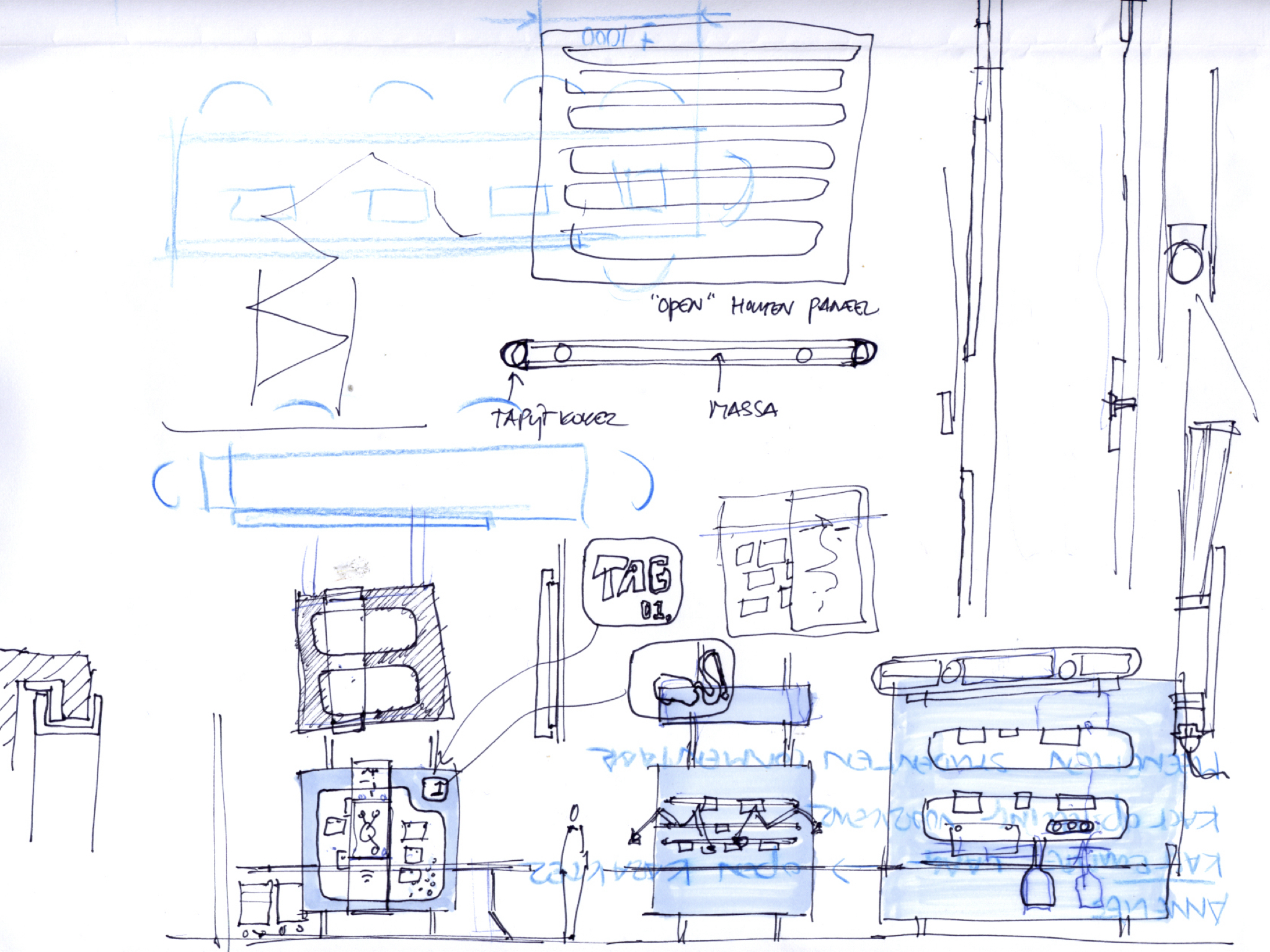
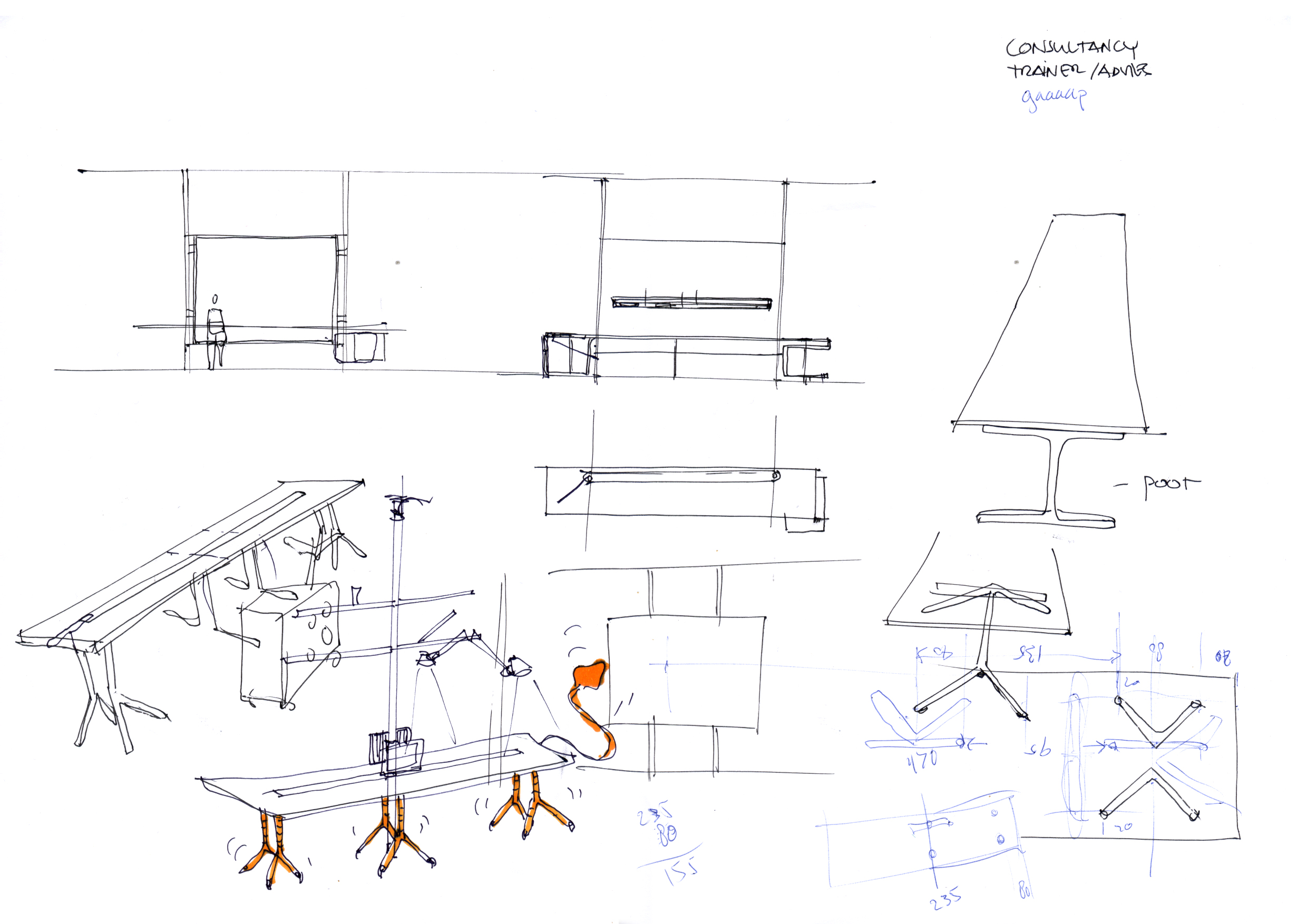
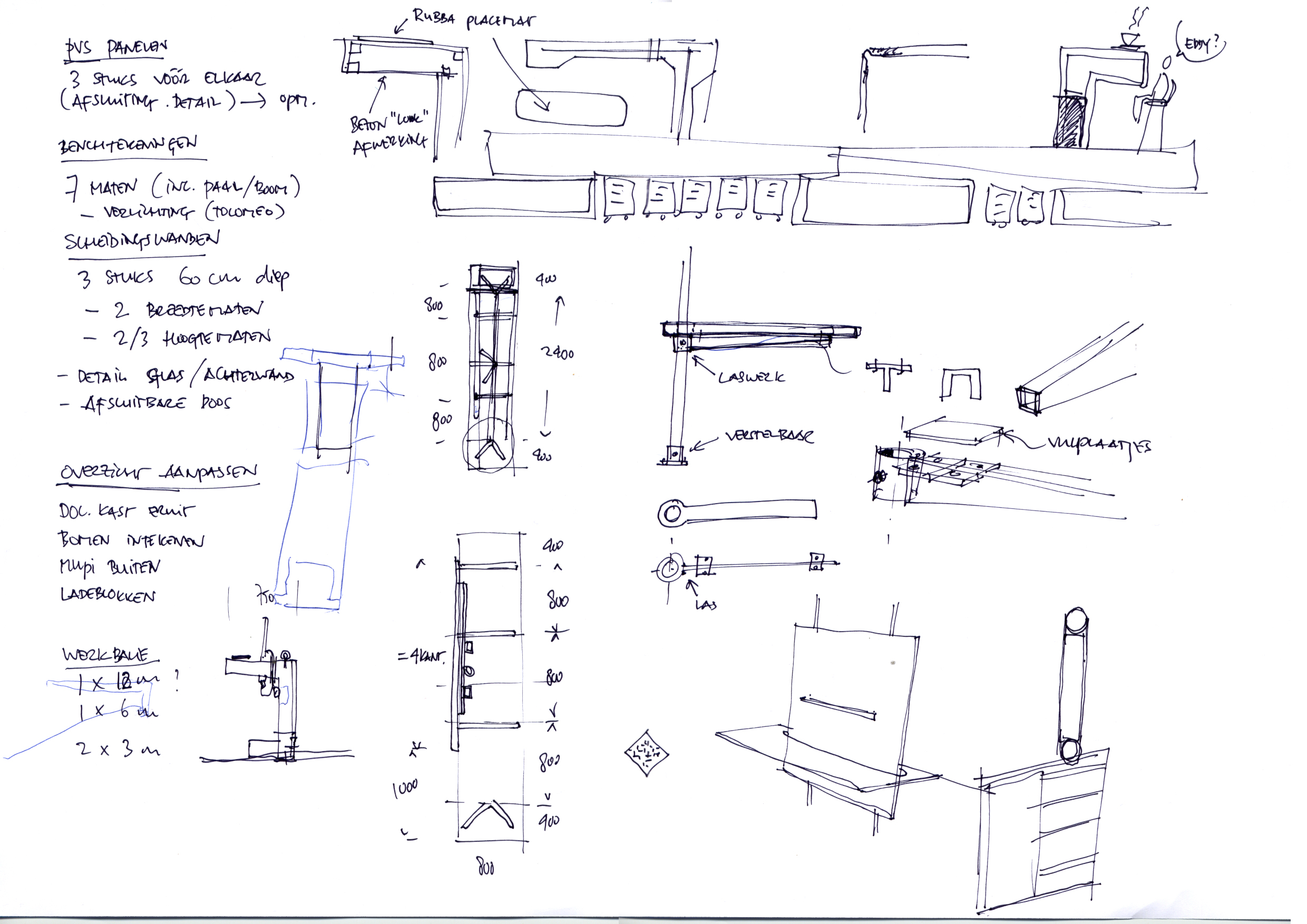
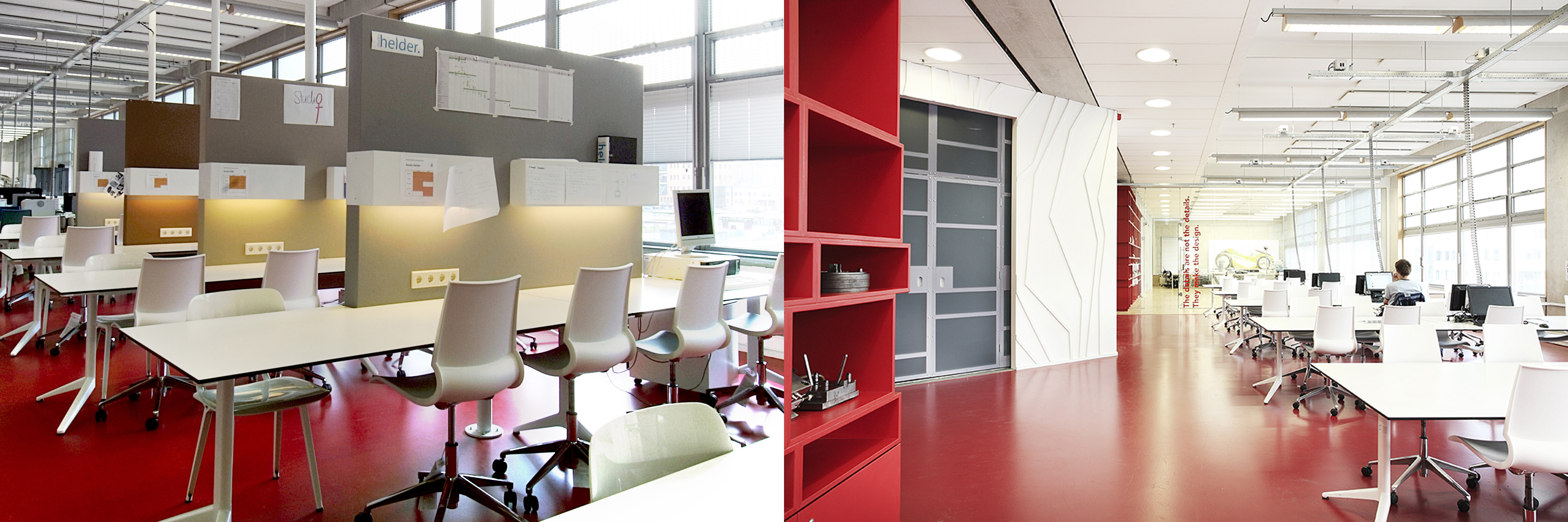
Yet, many design students (and design professionals) assume they will have to produce pretty sketches (in perspective) right from the start. Preferably rendered. This is a major pitfall!
The more you focus on the quality of your sketch, the less time and attention is available for creative thinking. And the more time you have spent on a sketch, the more resistance you will feel to experiment or make changes to the design.
But it gets worse: when you attempt to sketch in a fidelity that is higher than your current skill level, frustration levels will quickly peek and will knock you out of your creative flow before you know it!
If you struggle with perspective you are better off sketching in simple side views to stay in 'the zone'. Sketching in minimal fidelity is key to quickly getting your thoughts on paper in a visual format. This allows you (and your peers) to see the idea emerge in real time and makes it a lot easier to test your assumptions: will this idea work? will it look right? can it be made?
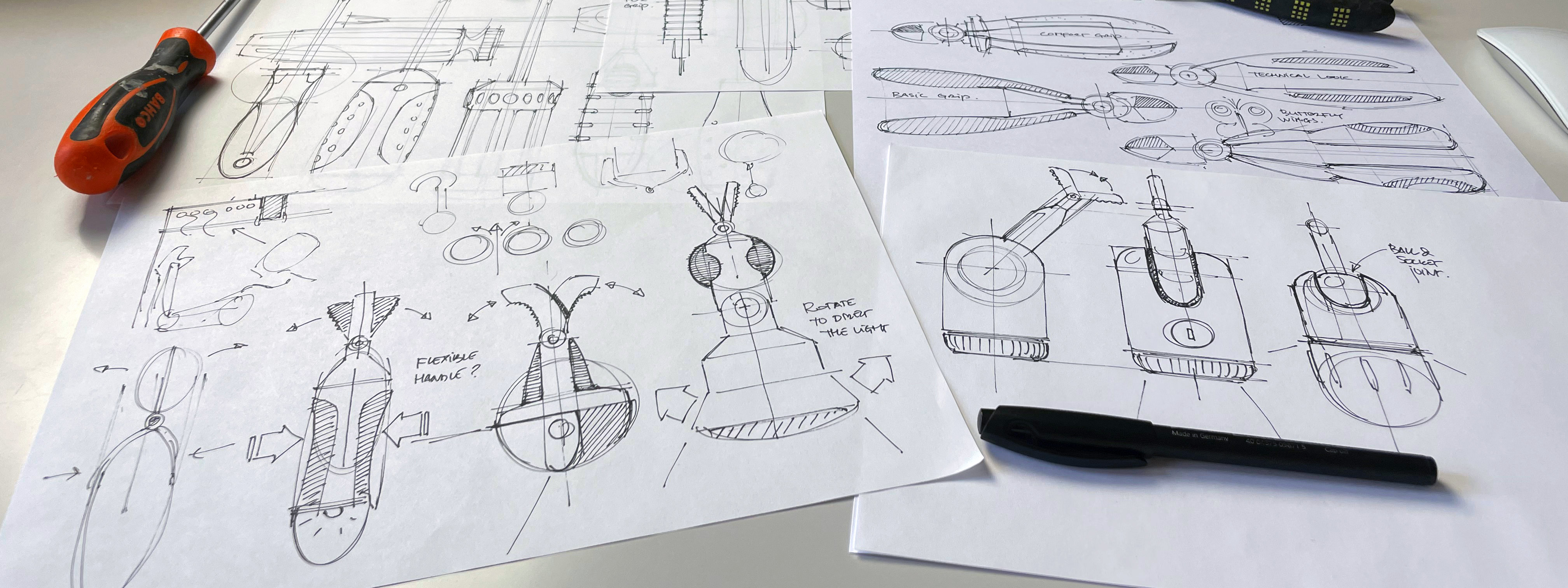
In that sense, sketching should be seen more like visual prototyping. It is one of the quickest ways to test if an idea will fly. But here's the kicker: this only works if you have enough confidence to visualise your ideas quickly and without the fear of making a mistake. In other words, you will first need to develop your sketching skill, before you can accept the 'mistakes' and doodle with confidence!
This is the paradox that I face as a teacher of design sketching: On the one hand I urge my students to master the skill of sketching in all facets (from straight lines and 3-point perspective to digital techniques). I even point out their weak spots and encourage them to do better. Yet, at the same time I tell them to drop the fidelity and not to worry about the quality as they apply their skill in the creative process.
For aspiring designers with little experience this can be a confusing message. Especially if you see stunning sketches everywhere in portfolios and social feeds. These examples can feel highly intimidating and can even discourage you from picking up the pencil. Many students feel they will never be able to reach that level.
What they don't realise is that the sketches they see online are carefully curated and you rarely get to see the messy exploratory sketches that came before.
The problem is that (unlike young kids) most designers feel highly uncomfortable sharing crappy doodles with others. A messy sketch signals a weak skill level. Others may get the impression that we are not so talented as we would like them to believe. It takes courage to produce messy sketches and share them with others, because it feels like we are underperforming.
The only way out is to experience the boost in creativity that you get from sketching without fear first-hand. Once you feel the raw creative power flowing through your hands onto the paper, you will know exactly what I mean.
Here's my action list to get you in the zone:
Train your motor skill to boost confidence (some tips to get your started)
Adopt some exploratory sketching habits (take my free online course)
Use shortcuts for sketching in perspective (check out my favourite cheat!)
Happy sketching!
4 comments

"What they don't realise is that the sketches they see online are carefully curated and you rarely get to see the messy exploratory sketches that came before."
This is a very recognizable statement for me. In my current process I use a lot of dirty sketches to communicate ideas or problems I foresee. Or even think things through myself visually. However, with a lot of these sketches, they don't feel presentable as is. This, for me is because of the fact that I am communicating a lot in the moment and not really communicating to convince, but more to converse.
That's exactly what I am talking about Max! And I argue that sketching messy is not easier. It actually requires enough training of some fundamentals to give you confidence to do this without fear.
I would say this applies somewhat to experienced sketchers as well— even more treacherously. It’s so easy to get carried away in the details— in a flow of sketching that doesn’t bring much ‘creative’ value, but perhaps simply looks nice. Because at the end of the day, a few things are bugging you, you add a few more lines, here and there, before you know it you whip out a marker—it’s only going to take 5min… 40 min later 🤡
Very much guilty ✋😁
Spending an hour on one drawing in the ideation phase means so much wasted potential for interesting insights from 6x10min sketches that could lead you into more diverse, rich and insightful territory.
In retrospect, I have to discipline myself more often with a ticking clock because otherwise I get carried away trying to make my mess pretty… 😛
So true Jakub and also guilty ✋
And there's also a counter argument to be made, because 'efficiency' should not be the only measure stick in a creative process. I believe there is a lot of subconscious processing going on whilst you are rendering and embellishing your sketches. More ideas are not always the best way forward. More thinking about an idea that you like can also lead to new insights and applying markers for shading/colour/storytelling can be a great almost meditative experience that allows your brain to ponder 'under the radar'.
One pitfall is that we start to fall in love with that idea, which makes it much harder to 'kill your darlings' when you do need to take a different route. The more time you invest in something the more you grow attached to it.
As long as you are aware of this I think it's actually a good thing to spend some more time with your idea. Especially in this day and age where AI can present us with hundreds of design ideas in a split second it can seem like the only job we designers have left is just to pick the best one. Ideas are plentiful.
Yet, experienced designers know very well that it's not really about the amount of ideas one can generate in the least amount of time. An idea is just a starting point. Creatives also know that ideas evolve over time and the best way forwards is making stuff to gain insight. The 'sketching to learn' philosophy falls into this line of thought.
Getting a bit carried away... 😄. I should probably turn this into a new post.
Thanks for sharing your thoughts Jakub!
Hey, I am Martijn
the 😃 behind @designsketching
Call me crazy, but I believe your hands hold creative superpower!
I aim to help you harness this power by sharing insights from 25 years in Industrial Design, Spatial Design and Design Education.
Are you struggling with sketching? Check out my online courses.
Advance your creative superpower!
Here are some free resources to get you started with the development of your sketching skill.
Freebies
Enroll to the Starter Track for €0
Train your mind to think through the pen and sketch without fear!
Download my reference book for €0
A guide to visual communication in Design and Engineering.
Access my Perspective Cheat-Pack for €0
Start sketching in perspective straight away!